
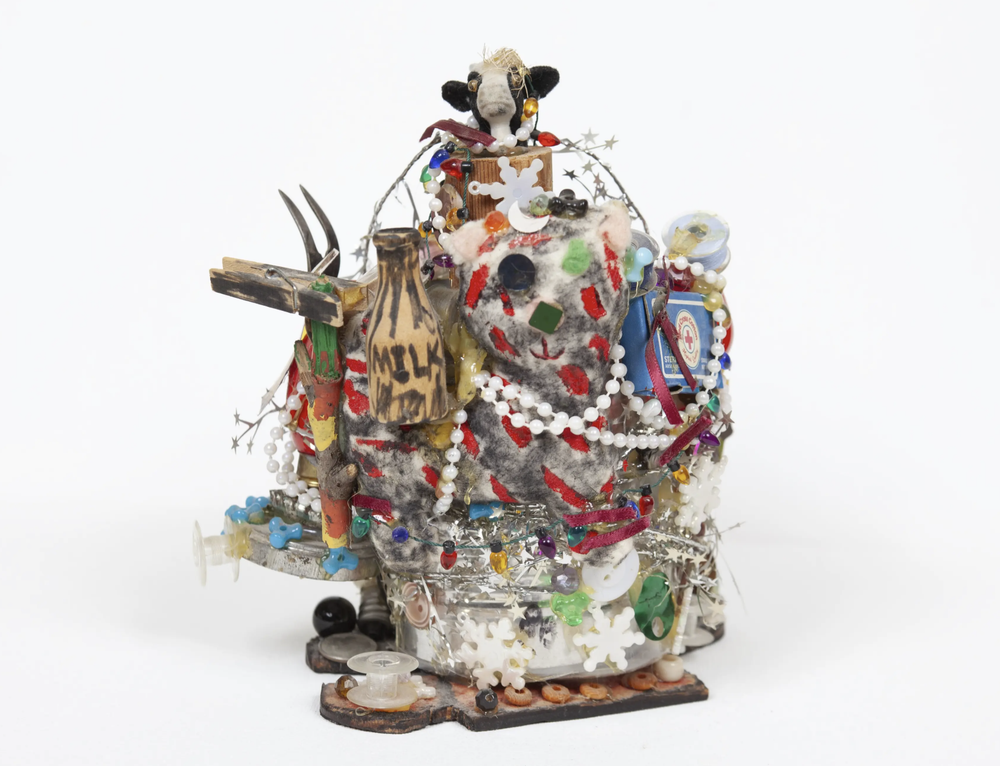
While living in Athens, Georgia, from the late 1980s to 2010, Beverly Buchanan (1940–2015) gifted her pulmonologist, pharmacist, neighbors, and friends a variety of impromptu artworks—sometimes out of gratitude and sometimes in lieu of payment. Juxtaposed with her better known sculptures, pastel drawings, and photographs of “shacks,” as she called them—which wrestled with the discrimination and economic disparity inherent in Southern vernacular architecture—the work on view in Beverly’s Athens surprises by showcasing the humorous side of the influential artist. Curated by artists Mo Costello and Katz Tepper for the Athenaeum, a contemporary art center affiliated with the University of Georgia and its Lamar Dodd School of Art, the show primarily sources from the collections of Buchanan’s local friends and community members, bringing together amusing, slapdash works, related ephemera, and a treasure trove of archival materials to offer a more expansive view of her years in the small Southern college town. In doing so, Costello and Tepper, both of whom have spent significant time in Athens, introduce a fresh approach to exhibition-making: demonstrating how lived experiences shape an artist’s process and suggesting that those relationships, circumstances, and spontaneous gestures are often fundamental to the artwork itself.
The exhibition reveals how Buchanan’s strong connections to her community and the alternative economy those ties helped create became essential to her survival as she navigated multiple chronic illnesses in her later years. In a letter to her New York City-based gallery in the early 1990s, Buchanan wrote, “Over the past decade, my health has dramatically deteriorated and many new allergies have cropped up as a result of many medications prescribed to treat these medical maladies.” She often approached her health challenges with self-deprecating caricatures, as in one particularly crude drawing, featured in a sketchbook, portraying herself in bed at Athens Regional Hospital. A quote above her head reads, “Person Ate Weird Food,” accompanied by rough sketches of a nebulizer, insulin, and a monitor displaying MTV. At the bottom of the drawing, she noted, “I was in the hospital. I’m out now. Feeling better.”
A substantial portion of the exhibition serves as a tribute to Hawthorne Drugs, Buchanan’s longtime pharmacy still in operation today, which she described in 1993 as “a social, friendly place, where you can eat lunch while waiting for your arthritis medicine.” In 1992, she crafted a chair from plastic compounding pharmacy spatulas, cut and pasted together in a manner similar to her acclaimed “shack” sculptures, for Andy and Debbie Ullrich, the owners of the pharmacy. (Debbie had given her the old spatulas, figuring she might enjoy working with them.) Hawthorne was a hub for Buchanan, as evidenced in the Polaroids, writings, and even a T-shirt she designed, titled PEOPLE EVERYWHERE COME TO HAWTHORNE DRUG (1993), depicting her trademark “shack” drawings surrounded by reasons why the pharmacy draws a reliable crowd, including, “competent care…clean air…fun people, chicken salad, nasty dogs.” The pharmacy also displayed, at various points, Buchanan’s hodgepodge spirit jugs, cobbled together homes, and lopsided chairs, all small sculptures made from a miscellany of found objects—like buttons, seashells, bobbins, beads shaped as Christmas lights, lag screws, ointment tins, bandage boxes, or a miniature straw sun hat balanced on a painted black silhouette. She was deeply appreciative of Andy and Debbie, who sometimes accepted these works in lieu of monetary payment. A postcard on display depicting one of her “shack” sculptures is cheekily inscribed: “For my pharmacist who I love very much … Yes, his wife knows.”
Beverly’s Athens also traces the artist’s interest in vernacular architecture and her findings in and around the Southern town. In one vitrine, snapshots of shotgun houses from South Rocksprings Street are accompanied by further research on Linnentown, a predominantly Black neighborhood that was contentiously demolished in the 1960s to make way for three dormitories as part of the University of Georgia’s urban renewal program. Alongside this research are photos of Buchanan working in her studio, a drawing of the same South Rocksprings Street homes she photographed, and a small whitewashed “shack” that formally reflects the often shoddy construction of structures that had survived gentrifying forces in the region. “I’ve read that my work is about nostalgia,” Buchanan wrote in September 2001 about her pieces referencing shotgun houses, dogtrot cabins, and other dwellings. “It is not. It is about ‘drawing’ with my camera and documenting old, former slave cabins turned tenement houses.… I have discovered that people live in some of these houses that have not dramatically changed.”
Arranged on a table in the exhibition’s Study Room, photos of a young Buchanan standing in front of sharecroppers’ homes reveal the inadvertent beginning of her lifelong influence. Her great-uncle and adoptive father, Walter Buchanan, was the dean of the agriculture school at South Carolina State University, and the two often traveled together through the Cotton Belt to meet with sharecroppers. She later traveled across the South for inspiration, too, taking photos of neighborhoods and homes while jotting notes on prescription pads, often from Hawthorne Drugs; these memos sometimes evolved into short writings about her sculpture’s proposed residents, portrayals that reflected amalgamations of family members and people she met along the way. Other sections of the exhibition are devoted to Buchanan’s Athens garden and home, and the yard sculptures on loan from the current property owner who’s kept them installed in the same places the artist originally sited them.
The show concludes with a typewritten draft of Buchanan’s 1990 semi-autobiographical story, “Reena’s Private Room.” Reena, like Buchanan, enjoyed making things from found scraps or odds and ends; “Her brother, David,” Buchanan described in the ending scene: would save any nails he found for her and discarded seed packets so she could cut out pictures of flowers and glue them to small sticks, place them in the ground in rows, making her own garden. Each row had a different type of blooming flower, from all over the world.… Her plants were always in bloom (she cut out new ones to glue when the colors faded) and they never died.
Beverly’s Athens, through its display of perfectly preserved ephemera, feels conceptually linked to this fictional garden—a tribute to the artist keeping her spirit, her wit, and radiant personality alive, always in bloom.
- Robert Alan Grand